Swimming with Whale Sharks in Nosy Be: 2026 Guide
A huge shadow beneath the surface, a mouth as wide as a garage door, white spots like a starry sky: swimming next to a whale shark is one of the most moving experiences the sea around Nosy Be can offer. The season is on right now. From Nosy Be, where we have been guiding travellers since 2017, here is when to go, what a trip is like and which rules to follow so the encounter stays wonderful for you and for the animal.

Why Nosy Be for whale sharks
Every year, whale sharks come to feed in the waters of north-west Madagascar, around Nosy Be. They follow small fish and plankton, and are often spotted near schools of tuna hunting at the surface. The Madagascar Whale Shark Project, a research programme based in Nosy Be, has identified more than 500 individuals through photo-identification: every whale shark has a unique spot pattern, like a fingerprint.
What makes Nosy Be special is that the population is mostly young males. During the 2022 season, researchers recorded sharks between 3 and 8 metres long. They are "juveniles", but trust us: when a 6-metre animal glides slowly beneath you, "small" is not the word that comes to mind.
More good news: the whale shark is a filter feeder. It eats plankton and small fish and poses no danger to swimmers. The only real issue is treating it with respect.
Season and best months
| Period | What to know |
|---|---|
| September | Start of the whale shark season. Humpback whales are still around Nosy Be. |
| October – November | The heart of the season, often the best time. Usually calm sea and warm water. |
| December | End of the season and start of the rainy season: showers are possible, so keep some flexibility. |
| January – August | Outside whale shark season. Time for other activities: islands, snorkelling, and humpback whales from July. |
An important reminder: these are wild animals. No serious agency can guarantee an encounter, even in the middle of October. If you are in Nosy Be for several days, we advise you not to book the trip on your last day, so there is a buffer in case of rough seas. For seasons across the country, read our article When to visit Madagascar.
What a boat trip is like
- Departure: we leave Nosy Be by boat in the morning. The briefing happens before we leave the beach: code of conduct, gear, how to enter the water.
- The search: this is the "safari" part. The skipper and the local guide scan the horizon: tuna churning the surface, seabirds, a dark shadow underwater. It can take time, and that is normal.
- Getting in: once a whale shark is spotted, the boat positions itself at a distance, without cutting across its path. You slip into the water calmly, without jumping or splashing, with your guide.
- The swim: you swim alongside the animal at the surface, keeping your distance. Depending on its behaviour, the encounter lasts a few seconds or much longer.
- The rest of the day: depending on the sea, we stop for a swim, some snorkelling or an island visit.
The code of conduct
In Nosy Be, a code of conduct for whale shark encounters was introduced by the Madagascar Whale Shark Project and is now part of Malagasy regulations. Skippers and guides in Nosy Be have also been trained by the Cétamada association, together with the Madagascar Whale Shark Project, in a respectful approach to sharks and whales. In practice:
- One boat per whale shark, and the boat stays at least 25 metres from the animal.
- At least 3 metres between swimmers and the shark. Never swim in front of its head or block its path.
- No more than one hour of interaction with the same shark.
- No touching, no grabbing, no "riding" the animal. Ever.
- No flash: we ask our travellers to shoot in natural light, without flash or lights.
- Small groups in the water: we prefer a few swimmers at a time, with a guide, rather than a whole group surrounding the animal.
- A trained skipper and an operator who follows the code: this is the number one criterion when choosing your trip, before price.
If a whale shark dives or moves away, we let it go. The shark decides how the encounter goes.

Humpback whales, dolphins, turtles: other encounters
The sea around Nosy Be offers much more than whale sharks:
- Humpback whales: they are found in the waters around Nosy Be from about July to November. In September, October and November, both seasons overlap.
- Dolphins: several species live around the island, including humpback dolphins that are sometimes seen close to the shore.
- Manta and mobula rays: Nosy Be is also a meeting place for these large rays.
- Sea turtles: present all year, you will often meet them while snorkelling.
Dreaming mostly of humpback whales? The east coast is another top spot: read our article Whale watching in Sainte-Marie.
Combine with Nosy Tanikely and Nosy Sakatia
A whale shark trip pairs very well with the nearby islands, on the same day depending on the sea, or over the following days:
- Nosy Tanikely: a marine national park and one of the best snorkelling spots in the archipelago, with its coral reef, colourful fish and turtles.
- Nosy Sakatia: a quiet little island west of Nosy Be, known for its sea turtles. Perfect for a slower day.
- Nosy Iranja: the most famous sandbank in Nosy Be; if you are travelling as a couple, read our guide Honeymoon in Nosy Iranja.
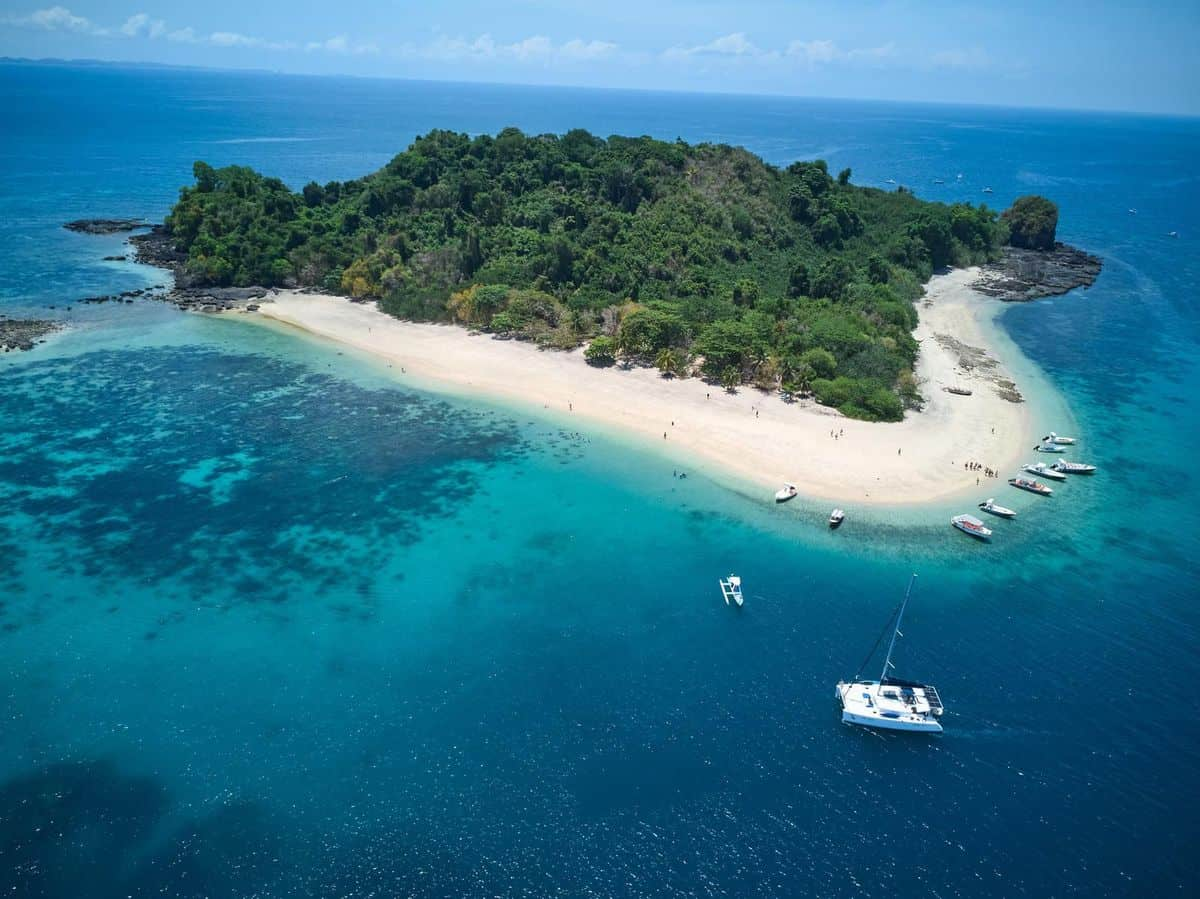
For everything the archipelago has to offer, see our article Things to do in Nosy Be.
Prices and practical tips
Price: whale shark trips are quoted on request, because the price depends on the date, the number of people and the boat. As a reference, our single-island excursions start from €50 per person, and our all-islands Nosy Be package (accommodation not included) is €385. Full details are in our article Nosy Be excursion prices.
- Book early for October and November: it is the busiest period.
- Be comfortable in the water: you swim in open sea with no visible bottom. Tell us if you feel less confident; we will provide a vest and a guide at your side.
- Bring your own mask if you have one that fits well: it makes all the difference.
- Protect yourself from the sun with a rash guard or UV T-shirt, a hat and reef-friendly sunscreen.
- Seasickness: the search can take a while; if you are prone to it, take precautions before leaving.
- Keep realistic expectations: a day without a whale shark is still a beautiful day at sea, and our guides will always show you something else.
Frequently asked questions
When can you swim with whale sharks in Nosy Be?
The season usually runs from September to December, often peaking in October and November. These are wild animals: sightings are never guaranteed, even in peak season.
Are whale sharks dangerous?
No. The whale shark is the largest fish in the world, but it feeds on plankton and small fish. The real issue is protecting it: keep your distance, never touch it and never block its path.
Do I need to scuba dive to see whale sharks?
No, the encounter is done snorkelling (fins, mask and snorkel) at the surface. You do need to be comfortable in open water; a buoyancy vest or wetsuit is a good idea if you feel less confident.
How much does a whale shark trip with Ma'Tour cost?
Whale shark trips are quoted on request, depending on the date, group size and type of boat. As a reference, our single-island excursions start from €50 per person and our all-islands Nosy Be package (accommodation not included) is €385.
Can you also see humpback whales in Nosy Be?
Yes, humpback whales are found in the waters around Nosy Be from about July to November. In September, October and November both seasons overlap, so a single trip can sometimes bring both encounters, with no guarantee.
Read next: diving and snorkeling in Nosy Be · a northern Madagascar road trip